Thursday, June 25, 2015

  |  No comments  |  

Politics of the pavement


By Gamini Abeywardane

The decision of Colombo Mayor AJM Muzammil to allow pavement hawkers back in the city has sparked a wave of protest from some opposition politicians. Deputy Minister Thilanga Sumathipala, Western Province Chief Minister Prasanna Ranatunga and Former Defence Secretary Gotabhaya Rajapaksa are among those who have publicly opposed this move.


Menace of hawkers and street sellers invading the pavement and blocking the passage of pedestrians was a burning issue in the city. Many Colombo based politicians in the past encouraged these hawkers in return for their vote and political ground support although they knew illegal occupation of pavements was causing embarrassment to general public.

 Politicians who were responsible for urban development have on several occasions tried to sort out this problem but were not successful amidst opposition from city politicians who backed the hawkers and such illegal occupiers. Present foreign minister Mangala Samaraweera when he was the Minister of Urban Development tried his best to clear the city of unauthorized occupiers but as a politician he too had limitations.

The only person who managed to do this effectively was former defence secretary Gotabhaya Rajapaksa. He succeeded because as a powerful official he did not care much about the political consequences. He also enjoyed the backing of his presidential brother to do all these things. He could be effective because politics did not come into whatever that came under his purview.

Politicians could not interfere with Gotabhaya and he had the liberty to conduct his affairs the way he believed to be right. It was the same way that he conducted the war against terrorism and that is one of the reasons why it succeeded. Thanks to him, people can move about in the city either on foot or by vehicle without the unruly hawkers obstructing their passage.

This sinister move by the Mayor to allow hawkers back in the city for his personal political advantage should be deplored by all. He has no moral or legal right to reverse something that has been painstakingly achieved for the benefit of the majority of the road users.

The argument that his suggestion is a temporary measure to allow street traders in the Ramadan season only in some places in Fort and Pettah is not acceptable. If he allows this in some areas then the pressure will come later to open other areas as well.  Why only in Ramadan season, there can be similar requests to allow street sales in Christmas season. Then comes Avurudu and Wesak too.

If the country is to move forward, city administration has to be professional and up to the international standards. We can achieve that only by depoliticizing the city administration and not by allowing political considerations to take priority in running the city.

The idea behind the recently passed nineteenth amendment to the constitution was to depoliticize the vital areas of government by introducing a number of independent commissions. Mr. Mayor, I am sure  you are aware that Prime Minister Ranil Wickremesinghe who is the leader of your party played a vital role to take politics out of these areas, firstly though the 13th amendment and later through the 19th amendment to the constitution. 

Your effort to re-politicize the city administration certainly goes against that policy. You are only helping some opposition politicians by providing them with a grand opportunity to raise their voice at a time they had lost their voice.


Tuesday, June 23, 2015

,   |  No comments  |  

Tinkering with constitutions and ignoring need for consensus

Despite much talk on constitutions and constitutionalism the reality is that we have been tinkering with constitutions for a half century and yet failed to have a proper one which the whole country can embrace with some sanctity. The main reason appears to be both our locally made or autochthonous constitutions were tailor made not for the people of this country but for the political groups that were in power at the time. This is clear from the constitutional history of our country.

By Gamini Abeywardane

The new government came with promises of constitutional change and much fanfare for political reform to ensure a fair society. All these promised changes are meant to be for the benefit of the people, for better democracy, for empowerment of the people and for lessor politicization etc. They are grand promises and if implemented honestly, should make Sri Lanka a better place to live in.

The actual issue is how much of honesty has been displayed by our politicians when it comes to constitutional making in the past. For whose benefit have they been made mostly? These are real issues one should look at. Especially with the passing of the 19th amendment, the proposed 20th amendment and the talk of an entirely new third republican constitution, the country, its intelligentsia in particular should give sufficient thoughts to these matters.

Despite much talk on constitutions and constitutionalism the reality is that we have been tinkering with constitutions for a half century and yet failed to have a proper one which the whole country can embrace with some sanctity. The main reason appears to be both our locally made or autochthonous constitutions were tailor made not for the people of this country but for the political groups that were in power at the time. This is clear from the constitutional history of our country.

Independent Ceylon’s first constitution popularly known as the Soulbury Constitution was given by the British. The Soulbury Commission was sent by the British government in 1944 to examine a constitutional draft prepared by the Ceylonese ministers of government and, on the basis of it, to make recommendations for a new constitution.

The constitution was accepted by all the communities in the country as minorities were given some sense of protection. Safeguard was provided for the minorities by Article 29(2) of the Constitution which prevented parliament from conferring benefits on the majority community and imposing disabilities on the minorities. With some minor amendments it lasted for quarter of a century without much controversy, probably because it was drafted after much consultation with all the communities over a period of about three years.

Then came the first republican constitution of 1972 and it is a well-known fact that the constitution was adopted by the constituent assembly without the participation of the Tamil community for whatever reasons. Probably the leaders at the time were in a hurry to bring about a rapid change having great socialistic ethos in their minds and failed to give much thought to the idea that a constitution is a consensus document which binds all the communities together.
Then came the second republican constitution of 1978 which introduced the executive presidential system. President J R Jayawardene, the architect of the constitution tailor made it for himself. The proportional representation was introduced mainly because he knew that even when the UNP was electorally defeated under the first past the post system they often had the majority vote count.  

With the new system in force JRJ thought that his party would never be defeated. One may argue that PR system is a far more democratic system because all minority groups also get their fair share of representation. Yet it is clear that JRJ’s immediate motive was not to give more democracy to the masses but to perpetuate the dominance of his party.

This attitude is quite clear from the way he centered near absolute power around the presidency with him in the chair. All the great values of democracy – rule of law, independence of the judiciary, the police and the public service were compromised under the might of the executive presidency.

After becoming the executive president he had the audacity to say that he had power to do everything other than making a man a woman and woman a man. If 1972 constitution had erred in not providing adequately for the minorities he could have well corrected that with his five sixth majority in parliament. Yet he failed to do so until he was forced to devolve power under Indian pressure. All that showed he too had a personal agenda behind his effort to introduce a new constitution.

The seventeenth amendment which provided for setting up of a constitutional council to recommend appointments to independent commissions covering vital areas of government such as the judiciary, public service, police, elections etc. was however an exceptional piece of legislation as it received the consent of all political parties in the parliament.

However at the same time that was a classic example of a piece of legislation that was rushed through the parliament without adequate time for debate. There was a great loophole in not providing for a quorum for constitutional council and as a result when a vacancy occurred due to death or resignation of a member the entire council became non-functional.
The eighteenth amendment was again another instance of strengthening one individual’s own position rather than resolving a constitutional issue. Declared intention of the eighteenth amendment was to rectify the anomaly in the seventeenth amendment and activate the constitutional council and other independent commissions.

However, President Mahinda Rajapakse used the opportunity to remove the term limit on the presidency allowing him to contest for the presidency for a third time and also took the power to appoint supposedly independent commissions into his own hand thereby making the executive presidency almost dictatorial.

Such is the history of our constitutional making where leaders responsible for drafting constitutions or amending them often acted for their own benefit ignoring democratic traditions or the well-being of the people. They have often acted as politicians and never as statesmen.

Contrary to our position some counties in the democratic world have drafted their constitutions after years of deliberation and consultation and with consensus among different communities and such constitutions have lasted long. For example the constitution of the United States has survived for the last two hundred and twenty five years while our neighbouring India’s first republican constitution promulgated in 1950 has lasted to date. These constitutions have received approbation of the people and nobody talks about introducing new constitutions in these countries.

For a constitution to be accepted by all and to last long it should be drafted following sufficient public debate and India has set a fine example in this regard. India’s constitution was drafted by the Constituent Assembly, which was elected by the elected members of the provincial assemblies. The members of the Constituent Assembly met for the first time on 9 December 1946

On 29 August 1947, the Drafting Committee was appointed, with Dr B. R. Ambedkar as the Chairman along with six other members assisted by a constitutional advisor. A Draft Constitution was prepared by the committee and submitted to the Assembly on 4 November 1947. Draft constitution was debated and over 2000 amendments were moved over a period of two years. Finally on 26 November 1949, the process was completed and Constituent assembly adopted the constitution.

Such are the rigors of constitution making for they are not simple documents prepared for the benefit of a few individuals. With the heat of the nineteenth amendment and the proposed twentieth amendment, the idea of an entirely new constitution has also surfaced again. If a third republican constitution is to be drafted it should be one that is accepted by all communities and it should last for at least hundred years.


Wednesday, June 17, 2015

  |  No comments  |  

Lanka’s growth figures good news for investors despite concern about political instability

By Peter Kohli

The Sri Lankan economy grew by 6.4 % in the first quarter of 2015, equaling that of the previous quarter. Manufacturing was up 6.5%, the service sector was up 7.5%, while agriculture barely registered any growth.

But the overall numbers should be good news for investors despite growing concern about possible political instability. Ever since the presidential election last January when Maithripala Sirisena won the election, thereby ousting long-time president Mahinda Rajapaksa, Sirisena has not enjoyed a majority government in parliament and is therefore unable to pass any reform legislation.

In fact, Prime Minister Ranil Wickremesinghe faces a no confidence vote in the next few days which, if successful, would mean immediate elections. This uncertainty has taken a toll on the markets, and the benchmark index Sri Lanka Colombo Stock Exchange All Share Index CSEALL is down nearly 3.5% YTD.

In a recent interview with CNBC, Sri Lankan Finance Minister Ravi Karunanayake, when asked whether the no confidence vote was an indication that the population was tired of the stagnant economy said, “Considering the fact that the economy we inherited is public debt driven, corrupted and without a focus, it is the incumbent president and the prime minister who have given Sri Lanka a new lease of life."

The consensus of opinion is that the former president, bitter over his defeat, is behind this no confidence vote. The current government is pro-West and I hope survives the vote. (www.nasdaq.com)

Monday, June 15, 2015

,   |  No comments  |  

Twentieth amendment need not be left to a future government


By Gamini Abeywardane

Maithripala Sirisena as the common presidential candidate promised many things to the people of this country. Among the most important of them were modifying the executive presidency and changing the electoral system. Both these have created major issues in democracy sometimes distorting it and muddied the political culture of our country.

As such there was general agreement among the majority of people that both these areas need change. That was perhaps the main reason why the people of this country voted for a change on January 8 surprising the world – a kind of transformation that world at large did not expect in a foreseeable future.

Now the executive presidency has been modified reducing much of its authoritarian nature. The term of the presidency has been reduced from six years to five while a two term limit has been set for one individual to hold the presidency. Introduction of the Constitutional Council which in turn will appoint eleven independent commissions for vital areas such as judiciary, public service, police, elections, finance, delimitation, audit, bribery and corruption will substantially democratize those areas.

The powers with regard to appointments, transfers, removal and disciplinary control of public service, judiciary and police have been taken away from the political control of the president. Depoliticization of these areas is expected to ensure fair play and increase people’s power, so that political influence will not affect the day- to-day functioning of police, judiciary or public service.

Electoral reforms

Yet with regard to the next most important area of the promised reforms there seem to be enormous difficulties when passing the relevant constitutional amendments. There is general agreement on removing the preferential system which has given rise to infighting within the same political party.

Then with regard to the proportional representation system the argument has been that it gives a value to every vote and it is a very democratic system. Mostly small political parties including minority parties seem to like it because it is advantageous to them. The reason is that in an absolute first past the post system is a case of winner takes all, while the main two political parties win most of the constituencies small parties often get washed out in the fray.

As we have seen in the past the only exceptions were the leaders of the political parties who were often popular figures in their own areas. There were also likes of W Dahanayake form Galle who could win even as an independent candidate. Gone are the days such independent candidates could win. Now the tendency is to back a winning party as most people support candidates expecting favours in a set up everything is politicized.

In an effort to clean the electoral process what has been proposed and accepted now is a mix of first past the post (FPP) and proportional representation (PR) systems though there is disagreement over numbers. A hybrid system of PR and FPP was proposed by a parliamentary select committee on electoral reforms headed by Dinesh Gunawardena sometime ago. But even the final report of the committee never saw the light of the day as the incumbent President was not keen on implementing any of the reforms.

Current debate

The idea of electoral reforms has surfaced again in the current political debate as the twentieth amendment to the constitution.  Several attempts to make it a reality after passing the 19th amendment has encountered obstacles due to the inability of the main political parties to agree on a formula for the mix.

The process started with the Elections Commissioner Mahinda Deshapriya proposing a package that envisaged the election to 140 seats through the first-past-the-post system, 80 through a district proportional representation system and 30 seats from the national list making a total of 250 seats.
After much debate the cabinet has approved a formula with 237 members out of which 145 will be elected on the basis of first past the post system and the balance from the national list. However now there seem to be disagreement again among the political parties on the numbers.

The SLFP together with some minority parties have backed the idea of increasing the number of seats in the parliament. However the UNP has expressed its opposition to increasing the number and wants to keep it at the present level of 225.In a situation where the UNP appears to be keener on early parliamentary elections than further constitutional amendments it is not clear whether its opposition to increasing the number of seats in parliament is a mere ploy to sabotage the 20th amendment.

This is all because the UNP believes early elections are advantageous to them. They feel that the threat of no confidence motions and the party's inability to be effective in parliament could make them unpopular day by day and an immediate election would give them a greater chance of winning a majority in parliament.

However the real issue before the country is different.  This government was brought into power on the promise of bringing about a fundamental change in the system of governance and the electoral process and thereby to reestablish proper democracy in the country. Therefore, there is a duty to deliver at least on the main promises during the tenure of this government.

The objective of the most of the UPFA parliamentarians who back former president Mahinda Rajapaksa  on the other hand, seems to be ousting Ranil Wickremesinghe government and running the country for the remaining part of the current parliament. Such a move will not receive the approval of President Sirisena as it will be contrary to the mandate he has received from the people. 
The mandate in short was to amend the constitution and the electoral process and to change the political culture of the country within a specified time and to dissolve parliament thereafter.

When it comes to changing the political culture changing the electoral process is an absolute necessity. It is the prevailing electoral system which has enabled the corrupt and undesirable characters to get elected to the parliament by throwing money. A person who has become unpopular in his own locality due to his corrupt and criminal activities can win votes from the other areas of his district by spending vast sums of money.

The preferential system of voting on the face of it appears to be very democratic and has worked well in some of the western European countries where the electorate is enlightened. But, our own experience has shown that it upsets the level playing field and distorts democracy instead of producing intended results. The net result here was that the educated and the cultured were prevented from entering the parliament because they often did not have the financial capacity to fight elections.

After all if we are to develop Sri Lanka as a modern democracy free of corruption we should elect proper people as our representatives in the country’s legislature and if we fail to do that everything else is bound to fail. From the people’s point of view it’s a case of sooner the better and reforming the electorate should not be left to a future government.


Wednesday, June 3, 2015

  |  No comments  |  

Unseen side of recent Jaffna incidents


The unfortunate chain of events that unfolded in Jaffna a few days ago could well be the first of that magnitude reported for quite some time. The mob was asking for the physical custody of several men who were accused of gang raping and killing a young girl while the men were being produced before a magistrate. Perhaps they were in a hurry to give the accused the harshest punishment without waiting for the usually slow legal process. Whether it was some spontaneous reaction from the people or the work of some organized group needs to be established through an independent inquiry.
However some who were bent on making easy political capital out of it were quick to say that these were the signs of terrorism raising its head again and this sort of things would not have happened if they were in power. It is rather unfortunate that such irresponsible statements are being made by our political leaders at a time national reconciliation is of paramount importance.

Protesters in Jaffna


If there were no such incidents or protests in that part of the country in the recent past it was not because people were very happy and they did not want to protest because they had a perfect administration there during that time. The simple reason was that the military was in tight control, there was no civil administration in the north and they did not have democratic space to engage in any kind of protest.

Protests are a normal thing in any democracy and you see many of them in Colombo almost every other week mostly in front of the Higher Education Ministry or the UGC. In a democracy what needs to be done is not to prevent protests, dissention or expression of different opinions, but accommodating them and taking notice of the causes behind such protests and taking remedial action.
However, this particular wave of incidents exceeded the limits of peaceful protest and developed to be mob violence destroying state property, obstructing police duty and attacking police personnel. Especially since these developments have taken place for the first time after ending terrorism there can be natural fears among the people as to whether there is any return of terrorism. That is why there is a need to have a thorough investigation into the matter to find out whether there was any political or other organized group behind it.

In the event there is no proof to say that there was such organized group behind it, naturally it follows that it was some spontaneous reaction from the people against dastardly and inhuman behaviour by a group of men against a female member of the society. Then the question will arise why such behaviour when there are law enforcement authorities to take appropriate action.

The possible answer is that during the many decades of terrorism there was no democracy in that part of the country. The LTTE which had practically absolute authority over the territory did not have a fair system of trial. They mostly resorted to summary trials or kangaroo courts and harshest punishments were meted out against whoever they thought had perpetrated a crime.  What people in the north majority of whom may be below the age of forty would remember is that kind of summary justice and not fair trials for every criminal.

The reaction of the Jaffna youth to the rape and murder in question would have naturally come from what they had seen and experienced in the immediate past and their ignorance as to how police and law courts function in a democracy. It will naturally take a reasonable time for them to experience what democracy is all about and see the value of having a fair system of justice.


Tuesday, June 2, 2015

  |  1 comment  |  

What ails our Public Administration


By R.M.B SENANAYAKE

It all began in 1956 when a new breed of parliamentarians emerged. They were from rural backgrounds and drawn from Ayurvedic physicians and vernacular school teachers. They were committed to the traditional indigenous culture and had little understanding of western institutions like liberal democracy. But now they would have to participate in its working.


They soon distorted the functioning of liberal democracy and our democracy became a popular democracy instead of a liberal democracy with checks and balances on the exercise of power.

They lacked any administrative experience and did not appreciate the difference between politics and administration- a distinction drawn in the West to demarcate the sphere of the politician from that of the administrator who belonged to a politically neutral permanent public service. The administrators were more educated and more sophisticated in their ways than the rural politicians.

The new politicians criticized the bureaucracy not for the red tape and slow methods but their class background calling them "a bamunu kulaya" (a caste of Brahmins).

These politicians were elected to the national Legislature and their duty was to be law-givers and not be part of the Executive. The Executive was however drawn from the Legislature and there was little difference between them and the Ministers. No qualification was required to be a Minister except the favor of the Party Leader who would be the Prime Minister. In the Presidential form of government the Ministers are not drawn from the Legislature but appointed from those who have administrative and management experience.

The new MPs wanted to exercise power particularly at the level of their electorate. So they intervened on behalf of their constituents with the district administration. Their constituents and political supporters wanted jobs in the government and the public sector which was looked upon as providing job security and pensions for life.

Those who were already employed in the government service wanted promotions and transfers. So these politicians interfered in the procedures for promotion and transfers in the public service. So the permanent administrators found it difficult to stick to the laid down procedures for transfers, promotions and discipline in the public administration.

The administrators found it difficult to resist these politicians. Some administrators themselves cultivated the political influence which was provided by the MPs. *Can there be an efficient administration if there is such interference by outsiders in the day to day decision making *according to laws and regulations? The theorists of Public Administration in the West would clearly say no.

They themselves did not face this type of problem. They only faced the problem of politicians seeking to influence appointments and recruitment to the public service. So they isolated the appointments and recruitments to the public service by setting up an Independent ‘Commission’ to lay down recruitment and promotion procedures and monitor their working to ensure they took place on proved merit and seniority rather than political influence. The independent Commission called the ‘Civil Service Commission’ managed to take out the recruitment of staff to the public service from the spoils system.

The West did not have the problem of political interference in internal promotions and transfers. The Ministers were expected to supervise the public departments to ensure that they functioned according to law and served the pubic impartially and fairly. They were not expected to interfere in the internal administration of the departments within their purview. Any organization cannot tolerate interference by outsiders in the internal management of such organization.

The hierarchical principle required that orders and commands must flow from the top to the bottom layers of the Department following the lines of authority. In the early years since Independence and right up to 1956 there was no flouting of the hierarchical principle. But the MPs and Ministers appointed after 1956 found it useful for them to convey orders to lower levels, listening to tales carried to them by the subordinate employees in the hierarchy such as clerks and peons. The Ministers listened to such tale carrying which is a bane in our society. The late Felix Dias Bandaranaike was the only Minister in my experience who confronted the official with the tale carrier. Hence there was hardly any tale carrying by subordinate officials and employees in the lower rungs against their bosses. The usual allegation was that the superior officer was working for the other political party and against the ruling political party.

Tales were concocted and some Ministers believed them and got rid of the officials against whom such allegations were leveled without giving them even a chance to explain their side of the issue. So sudden transfers to outlandish stations was the penalty these officials had to face for doing their duty. Soon the superior officers gave up their duty of supervision of the subordinates and their work and preferred to ignore their transgressions. *So efficiency disappeared* as no organization can act if the superior officers are not allowed to carry out their decisions. They also need to be protected by an independent Commission against those interfering in the internal administrative management of an organization. Last week a newspaper reported that the Chief Minister of the Uva Province distributed the letters of appointment to some new recruits called Development Assistants. He probably wanted to impress on the new recruits that they were being appointed by his favor.

Aren’t appointments to the public service a function of the provincial public service Commission? Why then should the Chief Minister distribute letters of appointment to new recruits? In fact the Chief Minister referred to the need for a politically neutral public service on the occasion. Was his action then proper? Of course this practice was adopted by the SLFP which is responsible for all such pernicious practices. But why should the so-called "yaha palanaya" government perpetuate such wrongful practices.

Theorists of Public Administration refer to several principles of Public Administration which must be followed to ensure efficiency. They recognize that Politics and Administration are two distinct categories and that we have to design the agencies of government in such a way as to separate them in order "to get administration out of politics". But when we turn to the actual work of government this is not easy. Public officials exercise discretion which involves the use of judgment.

But when officials exercise discretion hey have power. If the politicians are allowed to exercise their influence in an administrator’s decision making it means the administrator is exercising his power on the instructions of the politician. This, to a large extent is what is a happening in our public administration today. But the politician may take a partisan view rather than an objective view of the circumstances.

Apart from the need to avoid bias it must be noted that most decisions today are technical and require the consideration of several factors and the administrator may have to select the best or the least harmful decision. *The politicians may want to influence the decision regardless of these technical factors* which may be based on chemistry, medicine, mathematics or some other science.

So in such decision processes political influence can be harmful as for example in the effects on the environment. There may be no one to take up the environmental aspects. If the administrator has the freedom to decide without being influenced by the politician he could take a more balanced and objective view. The Nazis and the Communists ran one party states and eliminated liberal democracy. Just because the single party candidate of the Communist Party contested elections the Party claimed it was democratic.

There are several principles that should be followed for the efficient functioning of an agency or department. There is the principle of hierarchy, the principle of unity of command, span of control, the principle of co-ordination etc. No subordinate should be placed in a position where he has to follow several superiors violating the principle of hierarchy. Today our public administration is riddled with transgressions of the principles of good public administration.

A functioning democracy here liberty of the subject prevails must have a politically neutral public service and politically neutral administrative decision-making, This requires a politically neutral public service appointed on merit and allowed to function without interference by politicians. If not this talk of ‘yaha palanaya’ is mere eyewash. Let the so-called "yaha palanaya " Government practice the principles of good governance without playing lip service to good governance
(Courtesy: The Island)


,   |  No comments  |  

Finding a Path to True Democracy in Sri Lanka


By Asanga Abeyagoonasekera

“This country, with its institutions, belongs to the people who inhabit it. Whenever they shall grow weary of the existing government, they can exercise their constitutional right of amending it, or exercise their revolutionary right to overthrow it.” Abraham Lincoln.

Through historical narratives and human experiences mankind witnesses the shift from the power of one individual to a wider representational body. As colonial empires imposed draconian rules, it became impossible to govern the natives as the public believed in strengthening the representative system for their economic freedom and further political rights. Sri Lanka experienced historical political achievement with the passing of the 19th Amendment with a parliamentary majority. Such political progress will cut down the centralised power of the executive and moved towards the Prime minister and Parliament. At the memorial oration at the four-time Sri Lankan Prime Minister Dudley Senanayake, Dr. Karunasena Kodithuwakku noted that Senanayake, seeing it as early as 1972, was aware of the consequences of transferring a significant power to one person, thus objecting to the executive presidency.

Former presidents promised but failed to deliver. Incumbent Sri Lankan President Maithripala Sirisena factors in Sri Lankan political history as a leader who strengthened local democratic institutions at the expense of his own power, a first in post-independence Sri Lankan politics. It is our opportunity to strengthen independent institutions and depoliticise them. The Bribery Commission, a place which should be equal to all citizens without political interference will have a massive local and global impact on our nation to improve the Corruption Perception Index. Tackling political corruption among all politicians should be done without any interference as the urban councilors, provincial councilors, members of parliament or former heads of state are all representatives who represent us; there shouldn't be a difference in the process. Equality as a clause engraved in our constitution leaves the author questioning as to why the commissioner was summoned by the speaker. We should ask as to who must be summoned in an event of the speaker having an allegation.

For the 19th amendment to function smoothly, Sri Lanka requires representatives with the highest standards within a functional meritocracy in the State system. A majority of elected members lack basic education, a criteria that has to be looked at in the modern day world, unlike the past. The next parliamentary elections should bring in more statesman-like people who could contribute for the economic prosperity and to create a decent political culture. This could be done by the powerful ballot only and if this change is done we are looking at a brighter Sri Lanka; else it will be a repeat of the past.

A significant strength of our nation was taken away by the three-decade war. Recently, over a session at the Harvard Kennedy School, this author emphasised the grievous political loss to the country in the assassination of Dr. Neelan Tiruchelvan, Lalith Athulathmudali both Harvard scholars, Lakshman Kadirgamar, President R. Premadasa and many other leaders. These carefully planned assassinations weakened our State. It's time we strengthen our governance structure by bringing the right people for the top jobs.

We will face many more challenges in the coming months and years specially after ending insurgency and terrorism, especially to deal with the many clusters of the LTTE core group still in operation. To bring them to the reconciliation process to give up their idea of the Tamil Eelam will be challenging. The Tamil National Alliance should support the government’s reconciliation process and ensure other groups could engage with us.

A fault in the local decision-making at the policy level is its lack of consideration of research input from think tanks and research material, leading ad hoc decisions. Research input should be a priority and we should develop our research capability as a nation. National think tanks and others should welcome public opinion and ideas before policy decisions are implemented in the parliament.

It is important to consider the foreign migration of our talented youth to Australia, the US and many developed nations. A talented youth force is a necessity for nation-building. They need to be engaged in this important moment in time. It is important to look at mechanisms to attract expat Sri Lankan professionals back to our country, reverse the brain drain, like in India.

The 150th death anniversary of one of the greatest leaders through time, President Abraham Lincoln, was commemorated over the last month. President Lincoln ended a bloody civil war, which claimed over 600,000 lives, and ended slavery, while uniting a nation to ensure freedom for all. Resultantly, a greater nation emerged. We could draws lessons from Lincoln’s political will for our present day constitutional reform. As John Kerry said in his brilliant remarks during his recent visit to Sri Lanka, “…what my country discovered to our own anguish during our civil war there were no true victors only victims. You saw, I trust, that it is obvious the value of ending wars in a way that builds foundation for the peace to follow.”


(This article was first published by the Institute of Peace and Conflict Studies, New Delhi at

  |  No comments  |  

Constitutionalising patriotism: The simile of the cave?

By V.T. Thamilmaran

This article attempts to evoke some discussion on the emerging discourse on patriotism which has increasingly become a driving force in shaping affairs of State management. The modern State, being a constitutional State by all means, should be considered as a distinct entity from a brutal political power. It is through constitutionalism that the State is tamed and rationalised in all of its activities. The banner goes as the rule of law, in all jurisdictions.


However, going by the recent events in the post-Cold War world, what becomes manifestly evident is the arduous challenge posed by patriotism to constitutionalism and the responsive compulsion on the part of the State in a manner that is not always within the expected civic limits of a tamed and rationalised entity. Hence, there arises the need to revisit the scope and functional characteristic of the concepts of constitutionalism and patriotism in the modern world.

The numerous writings on constitutional patriotism, by castigating both liberal nationalism and national patriotism, attempt to promote a universalistic approach to political attachment of citizens to a particular nation State. Here, nationalists are seen as adopting the particularistic approach in having their loyalty pinned to the identity which is represented by their State. The attachment is purely based on the belief that loyalty results from identity. In contrast, constitutional patriotism is understood as ‘a civic form of loyalty’, a model based on parent-child relationship. In this context, loyalty results from a particular ‘political morality’.

Building on this idea of political morality and by examining the conceptual underpinning of these two concepts, this brief intends to go beyond the constitutional patriotism of Juren Habermas and argues that patriotism should be constitutionalised by adopting universal standards of ‘improvement’ via adhering to the principle of rule of law. It is argued that without ‘rule of law’ conformed to universal standards, patriotism is nothing but self-destructive. Again, the metaphor of parent-child relationship is invoked to elaborate this point.

It is attempted to look at the objective criteria of reasons for which a person becomes a patriot by loving his/her country and taking pride in it.

Constitutionalism and patriotism

Constitutionalism does not simply mean strict adherence to law. Not even the submission to the letter and spirit of the constitution. James Tully observed that “in modern constitutional polity, democracy is unavoidably linked to law. It suggests that, first of all, there should be a set of higher values and principles on which the (constitutional) polity has voluntarily agreed to come together and accordingly adopted the procedure for its ‘will formation’. This is what is meant by rule of law. In other words, the principle of constitutionalism clearly draws the distinction between rule by law and rule of law. In the latter instance, constitutionalism demands that even the will of that polity should not be exercised unreservedly but subject to those values and principles on which they have already agreed upon. It means that rule of law in a constitutional democracy sets limit on the very people’s sovereign self-determination. 

Accordingly, the will formation of the polity cannot violate human rights that ‘have been positively adopted’ as basic features or fundamentals of a constitution.Whereas patriotism, on the other hand, necessarily demands distinctiveness from “others” and for the purpose of it, sometimes, forces to forge an identity on the basis of convenient differences. Racial, ethnic, religious and linguistic differences could help the patriots to identify the others very easily, but, of course, with a sense of enmity. Furthermore, they don’t see any problem in supporting the enactment of any (positive) law for the sake of maintaining the status quo. This would either create a new group of minorities who would be totally alienated from the mainstream politics or marginalise the existing numerical minorities.

As opposed to constitutionalism, patriotism does not bother about equating political majority with numerically permanent majority within a State. The rise of nationalism in the aftermath of the Cold-War clearly demonstrates this phenomenon where what we witness is that all groups of people want to become a permanent majority for the sake of enjoying the power legitimately owned by the political majority. When the State responds to this desire of different small groups with much political clout, political morality bids farewell and particularistic narratives become success stories for the patriots. 

The sliding side of this exercise lies in the fact that they may even lead to the point where justification of assimilation policies adopted by a majoritarian State could be actively supported by the patriots. It has been proved time and again the possibility of evil regimes becoming led by patriots.Since these dangers were experienced by many of Germans by themselves during the World War II, they started to look for the way out and came with the idea of constitutional patriotism.

Constitutional patriotism

Although, originally, the concepts of constitutionalism and patriotism were forged together by some German scholars like Dolf Sternberger in the 1970s, it is the German philosopher Jurgen Habermas who started the academic discourse on the theory of constitutional patriotism almost during the same period.

The theory caught the attention of many academics in Germany as a response to ‘the general moral bankruptcy’ that engulfed the German society in the aftermath of the World War II. This academic treatise focused on the need to address the demand for a common German identity and thereby create a sense of ownership of affairs of a State in the minds of the citizens and advocating a form of civic empowerment. For this purpose, he advocated constitutional patriotism going beyond constitutionalism in legitimiding patriotism coupled with political morality.

However, Habermas’ conception of constitutional patriotism has created more confusion and invites severe criticism for varying reasons, one of which is the allegation that it is more Eurocentric and thereby loses its applicability as a universal theory. Also, with the unification of Germany, his theory of constitutionalism based on citizens’ mutual justification of political rule to each other becomes redundant. It doesn’t mean that the theory’s contribution to current constitutional and political debate on democratic accountability and understanding of the partnership between individual rights and the formation of constitutional norms is underestimated.

Constitutionalising patriotism

Constitutional patriotism presupposes the existence of a set of liberal principles such as freedom of speech and equality. But, since patriotism and nationalism remain as the two sides of the same coin, it is inevitable that one would trigger off the other. This would finally lead to what Habermas himself identified as ‘democratic deficit’ where rule by law is justified for the love of the country.
For anyone who lives in a constitutional State, attachment to his or her constitution is based on the premise that it represents the citizens’ legal and moral values. This representation becomes possible only if those norms are having the characteristics of rationality and legitimacy. If the Constitution does not provide for testing the legitimacy of the very legal system then the document would remain as a springboard for patriotism sans any political morality.

Constitutionalising patriotism simply means identifying those features of a constitution for which the citizens might perceive as ‘worth fighting for’. Consequently, love and loyalty would be tied down to certain core values according to which the ‘child’ should be protected and improved. Improvement is a relative term in constitutional matters as well.

Conclusion

One can only be rational in the practical life by the knowledge of the ‘other’ realm — the realm of pure truth. The real knowledge is only of use if one returns and applies it to the practical life. Those with the real knowledge must be prepared to fight hard for its acceptance and ensure their societies are governed according to the precepts of that knowledge. Otherwise, the cave will continue to smile at us.
(The writer is a law professor at the University of Colombo) – www.sundaytimes.lk


  |  No comments  |  

Is India's growth exaggerated?


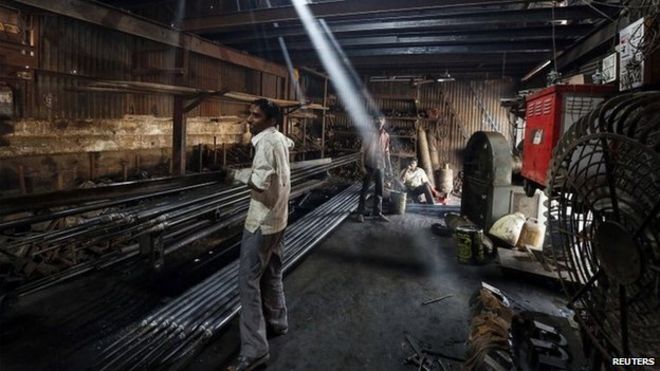
A worker carries an iron pipe inside a metal fabrication workshop in an industrial area of Mumbai February 9, 2015
Many experts say the economy is still waiting to gather momentum

Last week, India announced growth figures which would make the world envious.
Asia's third-largest economy grew 7.5% in the three months ending in March, higher than the previous quarter and above expectations. Forecasts were for growth of about 7.3% for the period compared with a year earlier.
But the new growth figures have come at a time when Indian companies are at their weakest in two years. Earnings are flat and profits are down. Most major industries, including infrastructure and automobiles, are struggling. Historically, says Business Standard newspaper, when India's growth has hit 7.5% at constant prices, corporate revenues and profits have soared above 14% on average. So how does the economy grow so fast when corporate growth is so slow?
A month after the government declared a new way of calculating GDP, India baffled experts in February when it announced 7.5% growth between October and December compared with the same period a year earlier. The latest figures again raise questions about the new way.
Some critics say the government is raising GDP figures to meet fiscal deficit targets, and trying to present a rosier picture of the economy. Economists such as R Nagaraj say the new and higher figures "seem quite at odds with other economic indicators such as growth in bank credit, the index of industrial production and corporate performance". Even the government's Economic Survey earlier this year found the new growth figures "somewhat puzzling" when compared to the falling savings, investments and exports.
India's government has defended the new way of calculating GDP by saying it is using an improved database for the private sector, in place of the earlier, smaller sample of large firms with high paid-up capital. It also said it had taken into account half a million companies which had been used for the first time in the series.
India's economy is a complex beast. There's a thriving "underground" or black economy which evades taxes, while more than 90% of India's workers are employed by small businesses which employ less than 10 workers.
"The new methodologies are very convoluted. So far, the increase in GDP does not appear to be reflected in the performance by companies and the markets. So either the government was getting it wrong all these years or they are presenting a far sunnier picture of the economy than it actually is," says analyst Paranjoy Guha Thakurta, who has been sceptical about the figures.
Economist Arvind Virmani calls this India's "growth puzzle". He says this can be explained by the "extremely dualistic nature of the Indian economy". On the one hand, the country has a small organised sector comprising mainly large state-run companies. On the other, it has a large, unorganised and informal sector, catering exclusively to its vast domestic market.
Dr Virmani says the collapse of global demand and excess capacity in goods and services have had a negative effect on globally integrated industries in all countries. "In India it means certain high quality, high skill segments of the organised, corporate sector. Thus Indian corporate sector growth is likely to lag, rather than lead India's growth recovery." (BBC Asia)
  |  No comments  |  

IPS Head says sensible import of Knowledge Workers okay


article_image by Sanath Nanayakkare

Dr. Saman Kelegama, Executive Director of the Institute of Policy Studies making a strong case for sensible liberalization of professional services recently said import of high quality Knowledge Workers is an option available for Sri Lanka, to deal with its current skills gap and to readily supply the talent pool today’s businesses need.

Kelegama made this remark addressing leading professional figures from diverse sectors who come together to share their thoughts at an interactive seminar held on the theme, ‘Liberalization of Professional Services, Challenges & Opportunities, Risks & Safeguards’, at the CA Sri Lanka auditorium last week.

"We do have world class professionals and knowledge workers in many sectors, but the numbers are lacking. So we might as well develop a mechanism with necessary safeguards to benefit from this option enabling knowledge transfer in the process, Kelegama said.

Providing actionable insights on tertiary and vocational education development in the medium and long term, he stressed the need to empower the youth through education reforms leading to flexible pathways to degrees.

He pointed out that the General Agreement on Trade in Services (GATS) could be used effectively in this regard which is a treaty of the World Trade Organization (WTO).

"If we make a clearly defined GATS binding, it can serve as an impetus to attract Foreign Direct Investments (FDIs) to Sri Lanka even without tax incentives. For GATS to work out beneficially, the regulatory framework has to be put in place," Kelegama noted.

"Our skills gap worsened over time due to several reasons; the professional brain drain between 1980s and 1990s, the setting up of new establishments related to healthcare, education, leisure sectors etc. which demanded more high quality professionals. Further, the global economic growth is driven by technological change. This required the service sector to be optimized to deliver superior performance.

Illustrating that import of knowledge and skilled workers is not new to Sri Lanka, he noted, "Now there are Chinese cooks in some restaurants that serve real ethnic Chinese food. Cricket coaches have come from other countries that play the ‘gentleman’s game’. Foreign doctors have worked here. And dating back to olden times, the Dawson Tower in Kadugannawa reminds us of the work done by the British royal engineer, he said.

"It’s reported that we need 15,000 construction industry personnel and we have only 11,000. A large number of doctors and nurses are required too. The US has the HB1 visa and Australia has the temporary business resident visa to redress this issue. For a developing country like ours, GATS framework could be the best choice, he said.

All members of the WTO are signatories to the GATS. The basic WTO principle of most favoured nation (MFN) applies to GATS as well. However, upon accession, members may introduce temporary exemptions to this rule.

Resource panel comprised Arjuna Herath, president, CA Sri Lanka, Saliya Pieris, Deputy President of the Bar Association of Sri Lanka, Reyaz Mihular, Managing Partner of KPMG and Dr. Ruvaiz Haniffa, Immediate Past Secretary of the Sri Lanka Medical Association.

Ranel Wijesinha, past president, CA Sri Lanka,and the Confederation of Asian and Pacific Accountants, who is also the founder of the Thought Leadership Forum was the moderator of the interactive session.

When the floor was opened for questions and there was absolute silence in the audience, Ranel said, "Now, this goes to show the fundamental characteristic of Sri Lankans. They keep quiet during the Q and A and start raising their fears and concerns at the cocktails."

That witty yet true remark did the trick and got everyone talking making it an animated and honest and candid discussion. One professional went on to say,"We’re beginning to sound like a small secret society trying to further our interests. We must consider the consumers’ point of view in this regard too. In this transforming economy, we must also take their opinion on board about their service providers."

Courtesy: The Island:  http://www.island.lk/index.php?page_cat=article-details&page=article-details&code_title=127403